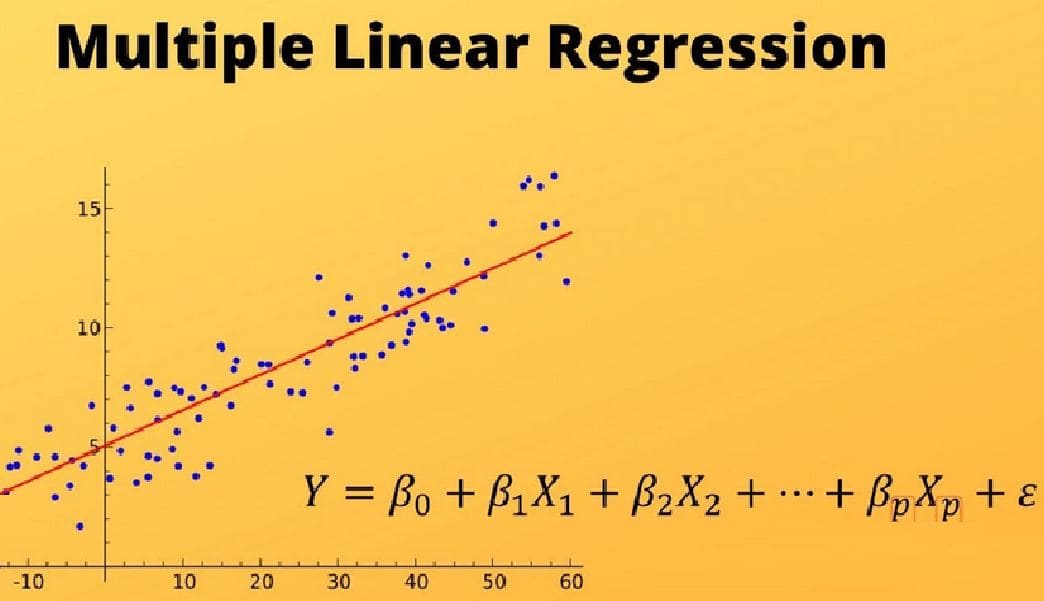
📘 Multiple Linear Regression
In real-world problems, outcomes rarely depend on a single factor. Instead, many variables influence the result. Multiple regression allows us to analyze the combined effect of several predictors.
🎯 Why Multiple Regression is Important
Most real-world predictions involve multiple variables.
Examples:
- House price depends on size, location, age, and number of rooms.
- Student performance depends on study hours, attendance, and prior knowledge.
- Sales depend on advertising, product price, and season.
- Machine learning model accuracy depends on training data size, feature quality, and algorithm complexity.
📐 Multiple Regression Model
The general form of the multiple linear regression model is:
\[ y = \beta_0 + \beta_1 x_1 + \beta_2 x_2 + ... + \beta_k x_k + \epsilon \]
Where:
- y = dependent variable
- x₁, x₂, ..., xₖ = independent variables
- β₀ = intercept
- β₁, β₂, ... = regression coefficients
- ε = error term
📊 Example — Predicting House Price
Suppose we want to predict house price using three factors:
- House size (square meters)
- Number of bedrooms
- Distance from city center
The regression model may look like:
\[ Price = 50,000 + 300(Size) + 10,000(Bedrooms) - 2,000(Distance) \]
Interpretation:
- Every additional square meter increases price by $300.
- Each additional bedroom increases price by $10,000.
- Every kilometer farther from the city reduces price by $2,000.
📈 Visualizing Multiple Regression
Unlike simple regression (which produces a straight line), multiple regression produces a plane or hyperplane.
- 2 predictors → regression plane
- 3+ predictors → higher dimensional surface
📊 Measuring Model Performance
Multiple regression models are evaluated using:
- R² (coefficient of determination)
- Adjusted R²
- Residual analysis
- Prediction error
Adjusted R²
Adjusted R² corrects R² when multiple predictors are used.
It prevents models from appearing better simply by adding unnecessary variables.
⚠️ Multicollinearity
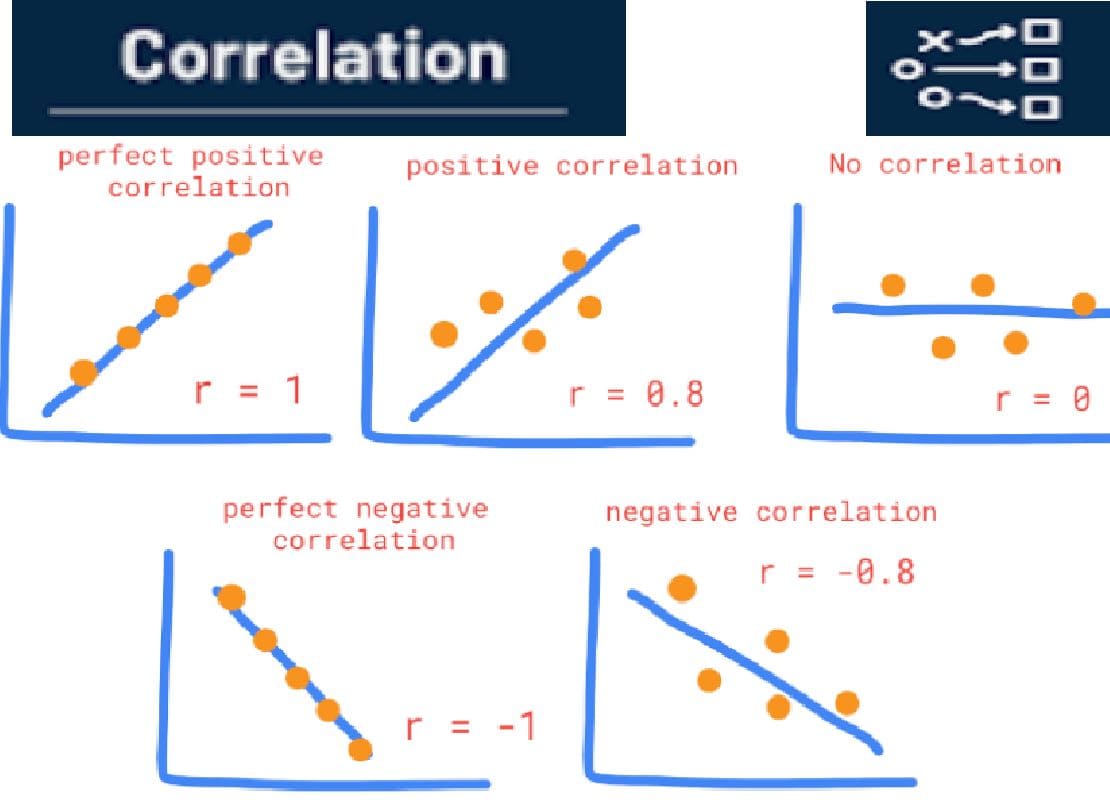
Multicollinearity occurs when independent variables are strongly correlated with each other.
Example:
- House size and number of rooms may be highly correlated.
This can make regression coefficients unstable and difficult to interpret.
🤖 Multiple Regression in Machine Learning
Multiple linear regression is widely used in predictive analytics and machine learning.
- Economic forecasting
- Housing price prediction
- Marketing analytics
- Risk prediction
- Demand forecasting
🧠 Key Insights
- Multiple regression models relationships involving several variables.
- Each coefficient measures the effect of one predictor while holding others constant.
- Adjusted R² helps evaluate models with multiple predictors.
- Multicollinearity can affect interpretation of coefficients.
- Multiple regression is the foundation of modern predictive modeling.