📊 Mean, Median, and Mode
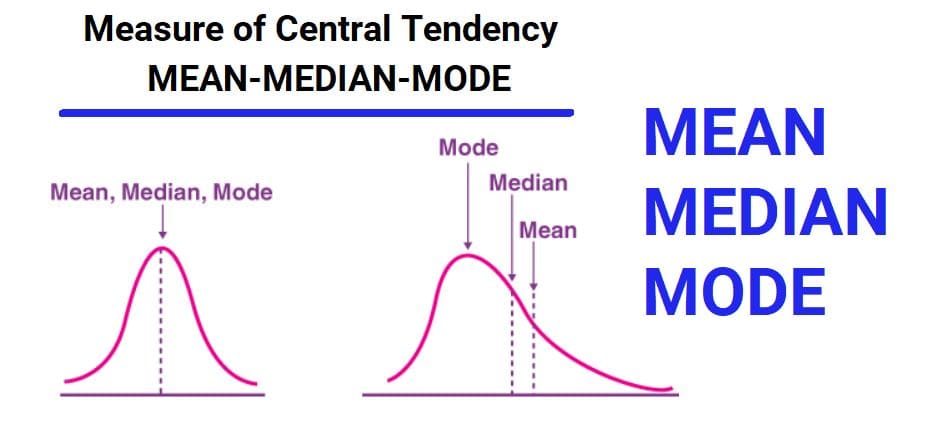
When studying data, we often want to find a single value that represents the center or typical value of a dataset. Mean, median, and mode help us identify patterns and trends more clearly.
🎵 Example: Ages of Choir Members
There are 15 children in a choir, all of different ages. Listing ages in order helps us spot patterns easily.
Ages (ordered):
8, 9, 10, 10, 11, 11, 12, 12, 12, 12, 12, 13, 13, 14, 15
➕ Mean (Average)
The mean is the average value of a dataset.
Mean = Sum of all values ÷ Number of values
Step 1 — Add All Ages
Sum = 172
Step 2 — Divide by Total Number of Children
Mean = 172 ÷ 15 = 11.46
Step 3 — Round the Result
Mean ≈ 11.5 years
📌 When Is Mean Useful?
- When all values are important
- When data does not contain extreme outliers
- For general performance averages
📍 Median (Middle Value)
The median is the middle number when data is arranged from smallest to largest.
Finding the Median (Odd Number of Values)
There are 15 ages, so the middle value is the 8th number.
Median = 12
Finding the Median (Even Number of Values)
Example: Test scores of 6 students:
65, 70, 75, 80, 85, 90
The middle two numbers are 75 and 80.
📌 When Is Median Useful?
- When data contains extreme values (outliers)
- For income statistics
- For property prices
- When you want the “typical” middle value
🔁 Mode (Most Frequent Value)
The mode is the value that appears most often in a dataset.
In the choir data, 12 appears five times.
Mode = 12
📌 Types of Mode
- Unimodal: One mode Example: 2, 3, 4, 4, 5 → Mode = 4
- Bimodal: Two values appear equally often Example: 1, 2, 2, 3, 3, 4 → Modes = 2 and 3
- Multimodal: More than two modes Example: 1, 1, 2, 2, 3, 3 → Modes = 1, 2, and 3
- No Mode: No repeated values Example: 5, 6, 7, 8 → No mode
📌 When Is Mode Useful?
- To find most popular items
- Customer preferences
- Survey results
- Fashion trends
🧠 Real-Life Examples
🍕 Example 1 — Favorite Pizza Slices Eaten
2, 3, 3, 4, 5
- Mean = 3.4 slices
- Median = 3 slices
- Mode = 3 slices
🏀 Example 2 — Basketball Scores
12, 15, 15, 18, 20, 22
- Mean = 17
- Median = 16.5
- Mode = 15
💰 Example 3 — Monthly Allowances ($)
20, 20, 25, 30, 35, 100
- Mean = 38.3 (affected by extreme value 100)
- Median = 27.5 (more realistic typical value)
- Mode = 20
📚 Comparison of Mean, Median, and Mode
| Measure | Meaning | Best Used When | Example Use |
|---|---|---|---|
| Mean | Average of all values | Data has no extreme values | Class average score |
| Median | Middle value | Data has outliers | Income levels |
| Mode | Most frequent value | Finding most common item | Popular product size |
✅ Why Measures of Central Tendency Matter
- They summarize large data sets
- They help identify patterns
- They simplify comparisons
- They support decision-making
- They help describe “typical” values