📘 Correlation: Measuring Relationships Between Variables
In many real-world problems, variables influence each other. Correlation helps us determine whether two variables tend to move together and how strong that relationship is.
🎯 Why Correlation is Important
Many scientific and business questions involve relationships between variables.
Examples:
- Does more study time increase exam scores?
- Do higher temperatures increase ice cream sales?
- Does advertising spending increase sales revenue?
- Does training data size improve machine learning accuracy?
📊 Types of Relationships Between Variables
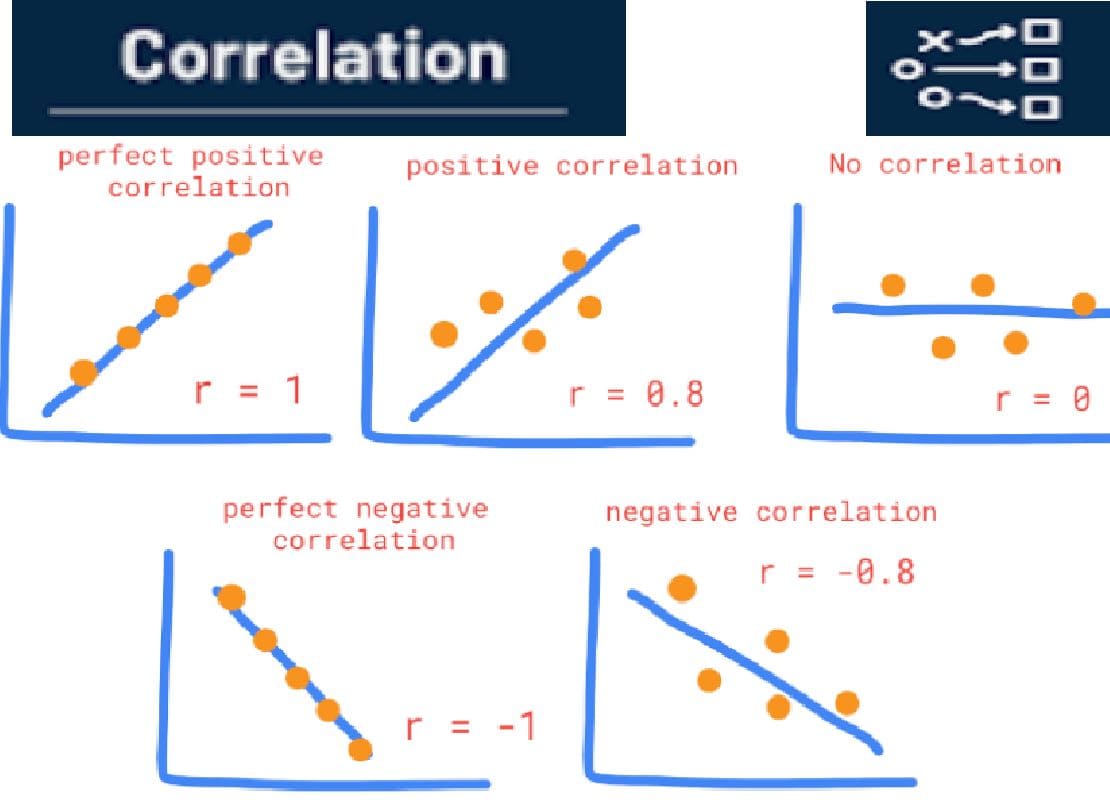
1️⃣ Positive Correlation
Both variables increase or decrease together.
Example:
- Study hours ↑ → Exam scores ↑
- Advertising budget ↑ → Sales ↑
2️⃣ Negative Correlation
One variable increases while the other decreases.
Example:
- Product price ↑ → Demand ↓
- Exercise time ↑ → Body fat ↓
3️⃣ No Correlation
The variables have no clear relationship.
Example:
- Shoe size vs intelligence
- Hair color vs exam scores
📈 Visualizing Correlation — Scatter Plot
The most common way to visualize relationships between two variables is using a scatter plot.
- X-axis → Independent variable
- Y-axis → Dependent variable
Each point on the graph represents one observation.
📐 Pearson Correlation Coefficient
The strength of correlation is measured using the Pearson correlation coefficient.
\[ r = \frac{\sum (x_i-\bar{x})(y_i-\bar{y})} {\sqrt{\sum (x_i-\bar{x})^2 \sum (y_i-\bar{y})^2}} \]
Where:
- r = correlation coefficient
- xᵢ = value of variable X
- yᵢ = value of variable Y
- x̄ = mean of X
- ȳ = mean of Y
📊 Range of Correlation Values
| Correlation Value | Interpretation |
|---|---|
| +1 | Perfect positive correlation |
| 0.7 to 0.9 | Strong positive correlation |
| 0.3 to 0.7 | Moderate correlation |
| 0 | No correlation |
| -0.3 to -0.7 | Moderate negative correlation |
| -0.7 to -1 | Strong negative correlation |
| -1 | Perfect negative correlation |
🔍 Example — Study Time vs Exam Score
Suppose we collect the following data:
| Study Hours | Exam Score |
|---|---|
| 2 | 50 |
| 4 | 60 |
| 6 | 70 |
| 8 | 80 |
| 10 | 90 |
When plotted on a scatter plot, these points show a strong upward pattern.
⚠️ Correlation Does Not Imply Causation
A common mistake is assuming that correlation means one variable causes the other.
Example:
- Ice cream sales and drowning incidents are correlated.
- But both increase because of hot weather.
📊 Correlation in Machine Learning
Correlation is widely used in machine learning and data science.
- Feature selection
- Detecting redundant variables
- Understanding relationships in datasets
- Building predictive models
- Reducing dimensionality
🧠 Key Insights
- Correlation measures relationships between variables.
- Values range from −1 to +1.
- Scatter plots help visualize relationships.
- Correlation does not prove causation.
- Correlation analysis is essential in machine learning and predictive modeling.