📘 Linear Regression — Foundations of Predictive Modeling
It helps us understand how one variable changes when another variable changes, and it allows us to make predictions based on that relationship.
🎯 Purpose of Linear Regression
Linear regression is used to answer questions such as:
- How does study time affect exam scores?
- How does advertising spending influence sales?
- How does house size affect house price?
- How does training data size affect ML model accuracy?
📊 Variables in Regression
Regression analysis involves two types of variables:
1️⃣ Independent Variable (Predictor)
The variable used to predict or explain another variable.
Example: Study hours
2️⃣ Dependent Variable (Response)
The variable we want to predict or explain.
Example: Exam score
📈 Simple Linear Regression Model
The relationship between two variables can be represented by the linear equation:
\[ y = \beta_0 + \beta_1 x + \epsilon \]
Where:
- y = Dependent variable
- x = Independent variable
- β₀ = Intercept
- β₁ = Slope (rate of change)
- ε = Random error
📐 Meaning of Regression Components
Intercept (β₀)
The value of y when x = 0.
Slope (β₁)
Represents how much y changes when x increases by one unit.
🔍 Example — Study Hours vs Exam Score
Suppose we collect the following data:
| Study Hours | Exam Score |
|---|---|
| 2 | 50 |
| 4 | 60 |
| 6 | 70 |
| 8 | 80 |
| 10 | 90 |
From the pattern we observe, the regression line becomes:
\[ Score = 40 + 5 \times StudyHours \]
This means:
- Every additional hour of study increases the score by about 5 points.
📊 Regression Line
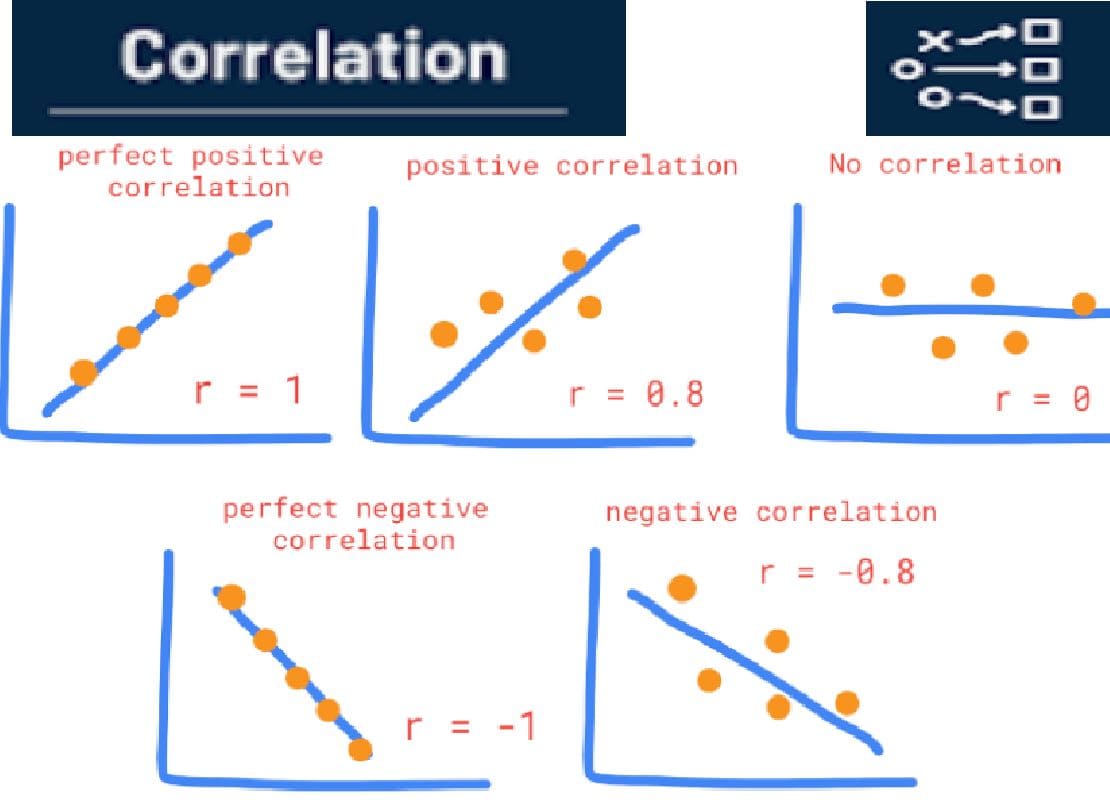
The regression line is the best fitting straight line through the data points in a scatter plot.
It minimizes the total error between the observed data and predicted values.
📐 Least Squares Method
The regression line is calculated by minimizing the sum of squared errors.
\[ SSE = \sum (y_i - \hat{y}_i)^2 \]
Where:
- yᵢ = actual value
- ŷᵢ = predicted value
Squaring ensures that positive and negative errors do not cancel each other.
📊 Measuring Model Fit — R²
The coefficient of determination (R²) measures how well the regression model explains the variation in the data.
\[ R^2 = \frac{\text{Explained Variation}}{\text{Total Variation}} \]
R² ranges from 0 to 1.
| R² Value | Interpretation |
|---|---|
| 0 | No explanatory power |
| 0.5 | Moderate explanatory power |
| 1 | Perfect prediction |
🤖 Linear Regression in Machine Learning
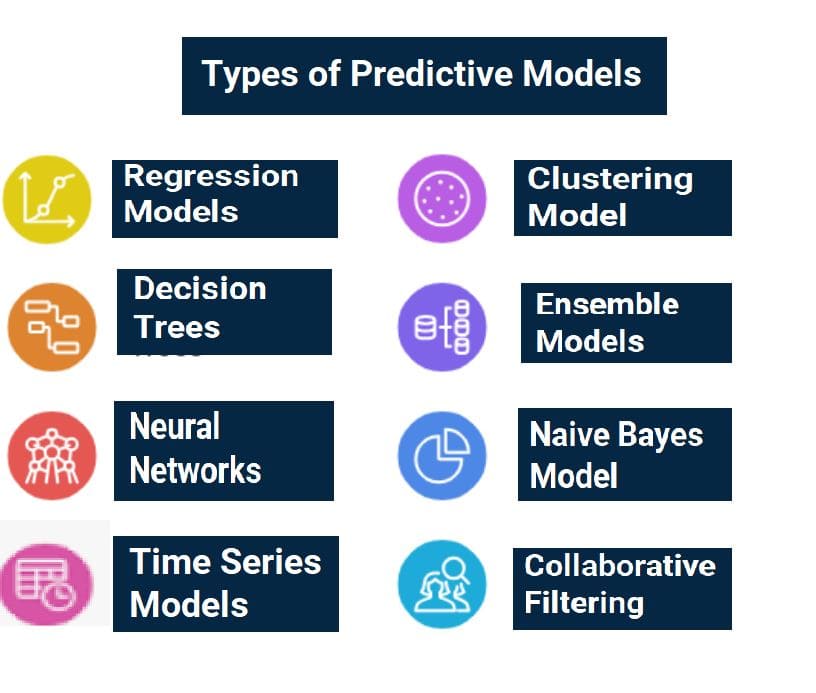
Linear regression is one of the most widely used algorithms in machine learning.
- House price prediction
- Stock price forecasting
- Demand prediction
- Sales forecasting
- Risk prediction
⚠️ Assumptions of Linear Regression
- Linear relationship between variables
- Independence of errors
- Constant variance of errors (homoscedasticity)
- Errors are normally distributed
🧠 Key Insights
- Linear regression models relationships between variables.
- The regression line predicts outcomes.
- The slope measures how variables influence each other.
- The least squares method finds the best fitting line.
- R² measures how well the model explains the data.
- Linear regression is the foundation of many ML models.