📘 Factors Affecting Confidence Interval Width
The width of a confidence interval determines how precise an estimate is. A narrower interval gives more precise estimates, while a wider interval indicates greater uncertainty.
Understanding what controls interval width helps in designing better studies and improving estimate reliability.
📏 What is Interval Width?
Confidence Interval Width = Upper Limit − Lower Limit
It depends on the Margin of Error (ME):
\[ \text{Width} = 2 \times \text{Margin of Error} \]
Larger margin of error → Wider interval → Less precision
Smaller margin of error → Narrower interval → Greater precision
🎯 Main Factors Affecting Width
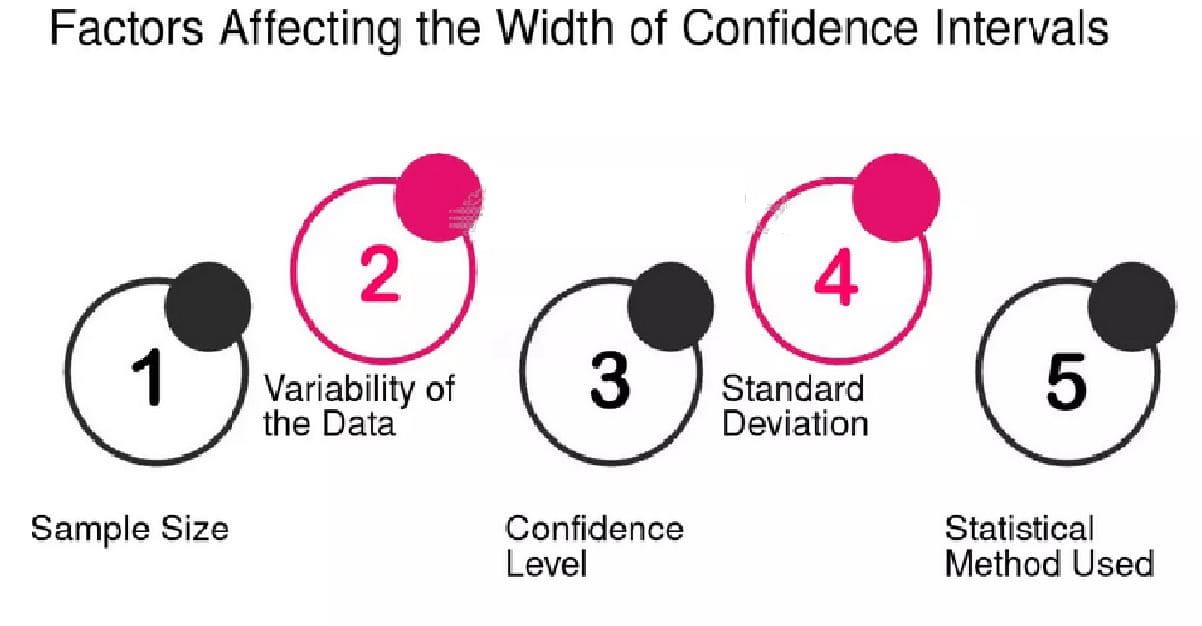
Three major factors influence how wide or narrow a confidence interval is:
- Sample Size (n)
- Confidence Level
- Population Variability (σ or s)
1️⃣ Effect of Sample Size
Sample size affects the Standard Error:
\[ SE = \frac{σ}{\sqrt{n}} \]
- Larger n → Smaller SE → Narrower interval
- Smaller n → Larger SE → Wider interval
More data produces more reliable and precise estimates.
🔢 Example
- Sample size = 25 → Interval width = Wide
- Sample size = 400 → Interval width = Narrow
Because √400 = 20 reduces variability much more than √25 = 5.
2️⃣ Effect of Confidence Level
Higher confidence levels require a larger Z or t value.
- 90% Confidence → Smaller critical value → Narrower interval
- 95% Confidence → Moderate width
- 99% Confidence → Larger critical value → Wider interval
Greater confidence requires a wider safety margin.
🔢 Example
Estimating average marks:
- 90% CI: (68, 72)
- 95% CI: (67, 73)
- 99% CI: (65, 75)
Higher confidence widens the interval.
3️⃣ Effect of Population Variability
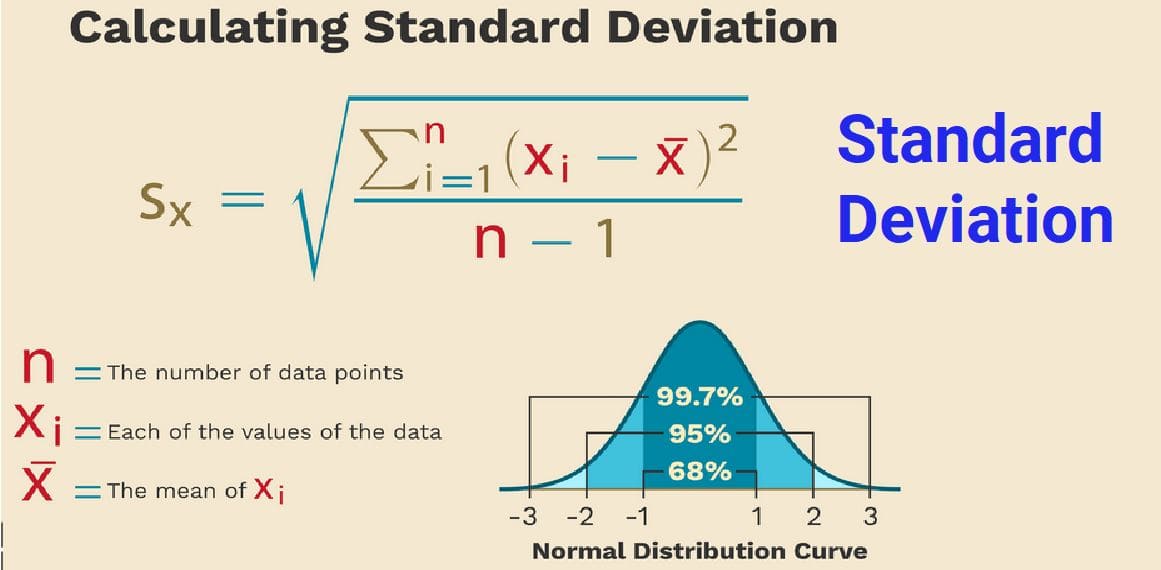
Greater variability in data increases the standard deviation.
- High variability → Wide interval
- Low variability → Narrow interval
Stable data produces more precise estimates.
🔢 Example
- Heights in one class vary greatly → Wide interval
- Heights in army recruits similar → Narrow interval
⚖️ Trade-Off Between Precision and Confidence
| Goal | Result |
|---|---|
| More Confidence | Wider interval |
| More Precision | Lower confidence |
| More Data | Higher precision & confidence |
The best way to achieve both high confidence and high precision is to increase sample size.
📈 Visual Intuition
Think of confidence intervals as safety nets:
- Narrow net → precise but may miss
- Wide net → safer but less precise
🤖 Applications in Machine Learning
- Evaluating reliability of model accuracy
- Comparing algorithm performance
- Deciding dataset size for training
- Understanding prediction uncertainty
More training data reduces uncertainty in ML predictions.
🧠 Key Insights
- Interval width determines estimate precision
- Larger samples reduce interval width
- Higher confidence increases interval width
- Higher variability increases interval width
- Balancing precision and confidence is essential