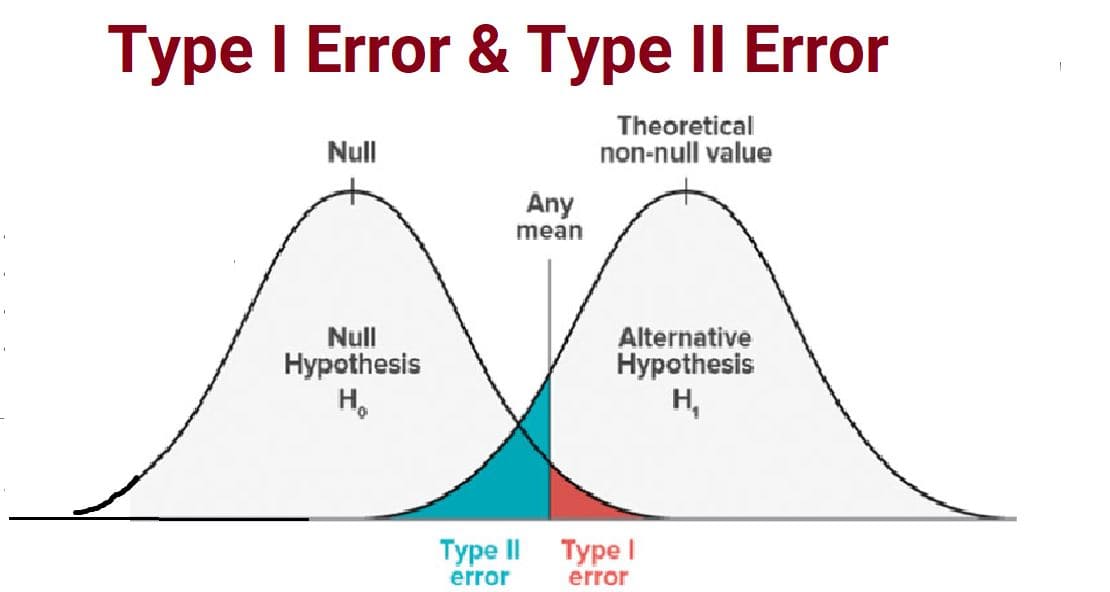
📘 Errors in Hypothesis Testing
Understanding these errors is essential for evaluating the reliability of conclusions.
⚖️ The Two Possible Errors
There are two kinds of errors that can occur when making decisions about hypotheses:
- Type I Error
- Type II Error
🟥 Type I Error (False Positive)
A Type I error occurs when we reject the null hypothesis even though it is actually true.
🔎 Meaning
We conclude that an effect exists when in reality there is no effect.
📌 Example — Medical Test
- H₀: Patient does not have disease
- Test result says patient has disease
- But in reality, patient is healthy
This is a false alarm.
📌 Example — Court Trial Analogy
- H₀: Defendant is innocent
- Court declares defendant guilty
- But defendant is actually innocent
This is wrongful conviction.
🟦 Type II Error (False Negative)
A Type II error occurs when we fail to reject the null hypothesis even though it is false.
🔎 Meaning
We conclude there is no effect when in reality an effect exists.
📌 Example — Medical Test
- H₀: Patient does not have disease
- Test result says patient is healthy
- But patient actually has disease
This is a missed diagnosis.
📌 Example — Court Trial Analogy
- H₀: Defendant is innocent
- Court declares defendant innocent
- But defendant is actually guilty
This is a guilty person set free.
📊 Summary Table
| Reality | Decision | Result | Error Type |
|---|---|---|---|
| H₀ True | Reject H₀ | Incorrect | Type I Error |
| H₀ False | Fail to Reject H₀ | Incorrect | Type II Error |
🎯 Probability of Errors
Type I Error Probability (α)
The probability of making a Type I error is called the significance level.
α (alpha) = P(Reject H₀ | H₀ is true)
- Common values: 0.05, 0.01
- Chosen before testing
Type II Error Probability (β)
β (beta) = P(Fail to reject H₀ | H₀ is false)
- Depends on sample size and variability
- Harder to calculate directly
⚡ Power of a Test
The probability of correctly rejecting a false null hypothesis is called the power of the test.
Power = 1 − β
🔎 Example
- β = 0.20 → Power = 0.80
- Test correctly detects effect 80% of the time
⚖️ Trade-Off Between Errors
Reducing one type of error often increases the other.
| If we make α very small | Effect |
|---|---|
| Harder to reject H₀ | Type I ↓ but Type II ↑ |
| Easier to reject H₀ | Type I ↑ but Type II ↓ |
🚨 Real-World Importance
Medical Research
- Type I: Approving unsafe drug
- Type II: Rejecting life-saving drug
Manufacturing
- Type I: Rejecting good products
- Type II: Accepting defective products
Machine Learning
- Type I: Claiming model improved when it didn’t
- Type II: Missing genuine improvement
🤖 ML Connection — False Positives & False Negatives
Hypothesis testing errors relate closely to ML classification errors:
| Hypothesis Testing | Machine Learning |
|---|---|
| Type I Error | False Positive |
| Type II Error | False Negative |
🧠 Key Insights
- Statistical decisions can be wrong due to sampling variability
- Type I error: False alarm
- Type II error: Missed detection
- α controls Type I error rate
- Power measures ability to detect real effects
- Error trade-offs must be managed carefully