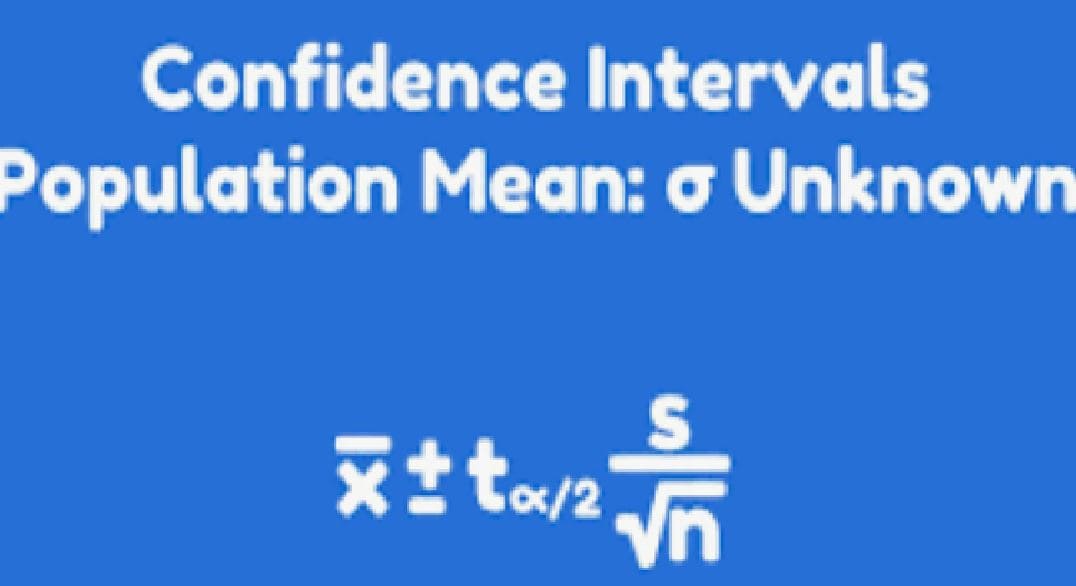
📘 Confidence Interval for Population Mean (σ Unknown)
This situation is more realistic because population variability is rarely known in practical studies.
🎯 Objective
To estimate the true population mean (μ) when population variability is unknown.
📐 Why Not Use Z-Distribution?
When σ is unknown, replacing it with sample standard deviation (s) introduces additional estimation error.
- Sample standard deviation varies from sample to sample
- This adds extra uncertainty
- Z-distribution underestimates this uncertainty
📊 Properties of the t-Distribution
- Bell-shaped and symmetric (like normal distribution)
- Has heavier tails (more spread)
- Accounts for extra uncertainty in estimating σ
- Shape depends on Degrees of Freedom (df)
📏 Degrees of Freedom
Degrees of Freedom (df) measure the number of independent values used to estimate variability.
\[ df = n - 1 \]
- n = sample size
📊 Standard Error (Estimated)
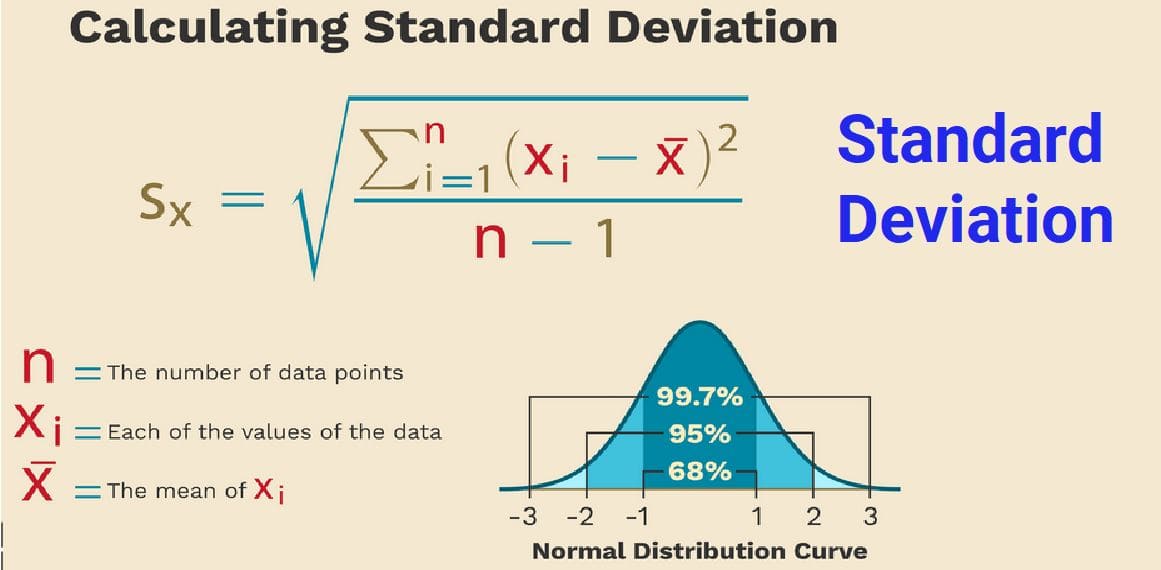
Since σ is unknown, we estimate Standard Error using sample standard deviation:
\[ SE = \frac{s}{\sqrt{n}} \]
📐 Formula for Confidence Interval
\[ \bar{x} \pm t_{\alpha/2, df} \cdot \frac{s}{\sqrt{n}} \]
Where:
- x̄ = Sample Mean
- t = t-score from t-table
- s = Sample Standard Deviation
- n = Sample Size
- df = n − 1
🔢 Example 1: Estimating Average Battery Life
Given:
- Sample mean battery life = 10 hours
- Sample standard deviation = 2 hours
- Sample size = 25
- Confidence level = 95%
Step 1: Degrees of Freedom
df = 25 − 1 = 24
Step 2: Standard Error
\[ SE = \frac{2}{\sqrt{25}} = \frac{2}{5} = 0.4 \]
Step 3: t-value
From t-table for 95% confidence and df = 24:
t ≈ 2.064
Step 4: Margin of Error
\[ ME = 2.064 \times 0.4 = 0.826 \]
Step 5: Construct Interval
10 ± 0.826
📊 Interpretation
The wider interval reflects added uncertainty from estimating σ.
⚖️ t-Distribution vs Normal Distribution
| Feature | Z-Distribution | t-Distribution |
|---|---|---|
| Population SD | Known | Unknown |
| Spread | Narrower | Wider |
| Tail Thickness | Thin tails | Heavy tails |
| Depends on df? | No | Yes |
📈 When to Use t-Distribution
- Population standard deviation unknown
- Sample size small (n < 30)
- Population approximately normal
- Random and independent sampling
🤖 Applications in Machine Learning
- Estimating true model performance with small validation sets
- Evaluating uncertainty in experimental results
- Comparing algorithms using limited data
- Estimating real-world prediction accuracy
🧠 Key Insights
- Use t-distribution when σ is unknown
- Degrees of freedom control shape of distribution
- Smaller samples → larger uncertainty
- Interval is wider than Z-interval
- t-distribution approaches normal for large samples