The Squeeze Theorem
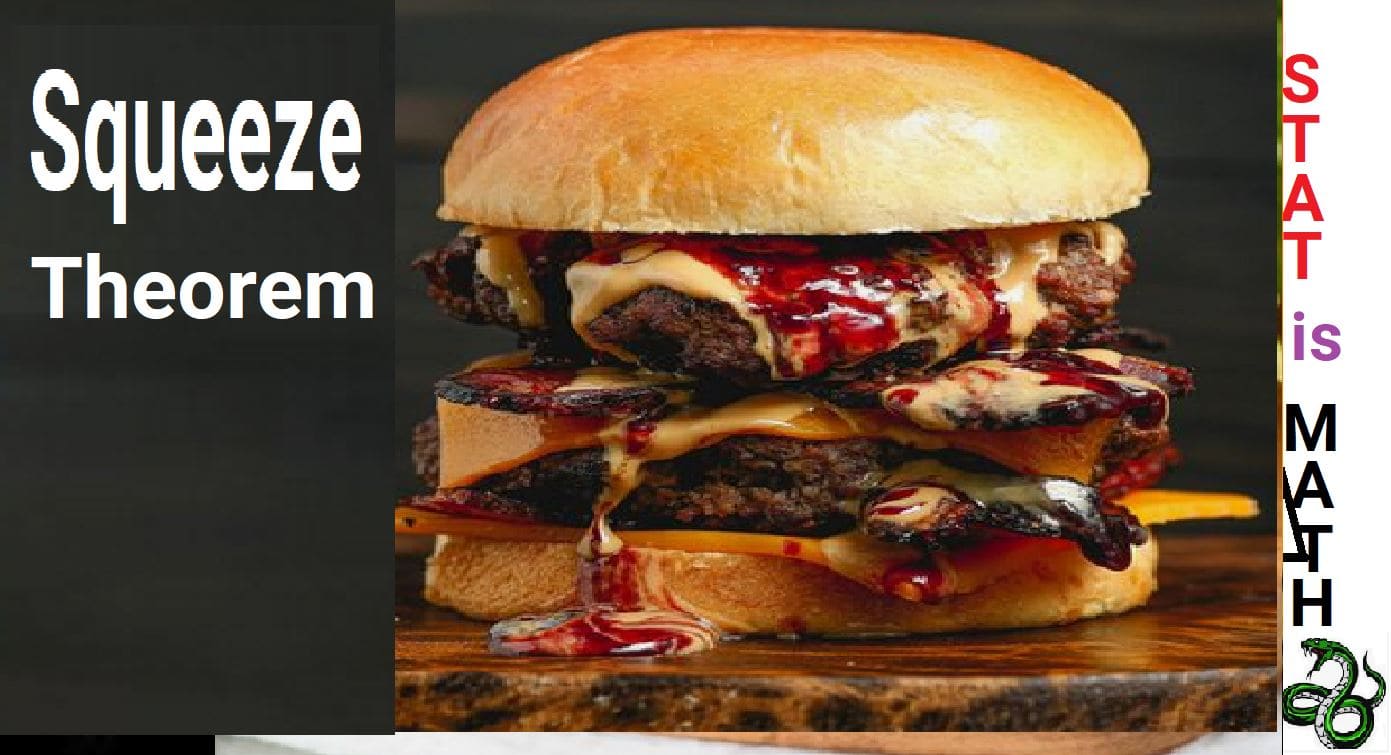
The Squeeze Theorem, also known as the Sandwich Theorem or Pinching Theorem, is a fundamental concept in calculus that helps evaluate the limit of a function by comparing it to two other functions whose limits are easier to compute. The theorem states that if a function is "squeezed" between two functions that have the same limit at a particular point, then the limit of the squeezed function must also be the same at that point.
Mathematically, the Squeeze Theorem can be written as:
\[ \text{If } f(x) \leq g(x) \leq h(x) \quad \text{for all} \quad x \text{ near } a, \]
\[ \text{and } \lim_{x \to a} f(x) = \lim_{x \to a} h(x) = L, \]
\[ \text{then } \lim_{x \to a} g(x) = L. \]
In simple terms, if \( f(x) \) and \( h(x) \) both approach the same value \( L \) as \( x \to a \), and if \( g(x) \) is "stuck" between \( f(x) \) and \( h(x) \), then \( g(x) \) must also approach \( L \) as \( x \to a \).
The Squeeze Theorem is particularly useful when we cannot directly compute the limit of a function, but we can find two simpler functions that bound the function from above and below. It is also helpful in cases where the function behaves in a way that is difficult to analyze directly, such as oscillating functions or functions with complicated behavior near a limit.
In many problems, the Squeeze Theorem provides a way to "squeeze" out the limit of a function when other methods are not easily applicable.
Let’s consider the function \( f(x) = x^2 \sin\left(\frac{1}{x}\right) \) as \( x \to 0 \). Directly evaluating the limit is difficult due to the oscillatory behavior of the sine function. However, we can use the Squeeze Theorem.
First, notice that \( -1 \leq \sin\left(\frac{1}{x}\right) \leq 1 \). Therefore:
\[ -x^2 \leq x^2 \sin\left(\frac{1}{x}\right) \leq x^2 \]
As \( x \to 0 \), both \( -x^2 \) and \( x^2 \) approach 0. Since \( x^2 \sin\left(\frac{1}{x}\right) \) is squeezed between these two functions, the limit of \( f(x) \) as \( x \to 0 \) is also 0:
\[ \lim_{x \to 0} x^2 \sin\left(\frac{1}{x}\right) = 0. \]
The Squeeze Theorem helped us compute the limit even though the function itself oscillates as \( x \to 0 \).
Consider the function \( f(x) = \frac{\sin(x)}{x} \) as \( x \to 0 \). We can use the Squeeze Theorem to evaluate the limit of this function.
We know that for all \( x \), the following inequality holds:
\[ -1 \leq \frac{\sin(x)}{x} \leq 1. \]
As \( x \to 0 \), both \( -1 \) and \( 1 \) have limits equal to 1. Therefore, by the Squeeze Theorem:
\[ \lim_{x \to 0} \frac{\sin(x)}{x} = 1. \]
Try the following exercises to apply the Squeeze Theorem:
- 1. Evaluate the following limit using the Squeeze Theorem: \[ \lim_{x \to 0} x^2 \sin\left(\frac{1}{x}\right) \]
- 2. Use the Squeeze Theorem to evaluate: \[ \lim_{x \to 0} \frac{\sin(3x)}{x} \]
- 3. Show that the limit of \( \frac{\sin(x)}{x} \) as \( x \to 0 \) is 1, using the Squeeze Theorem.
- 4. Find the limit of \( f(x) = \cos(x) \cdot \sin\left(\frac{1}{x}\right) \) as \( x \to 0 \).
5. How can the Squeeze Theorem be used in machine learning models, particularly when dealing with optimization algorithms like gradient descent? Can you think of a scenario where the Squeeze Theorem might help in understanding the convergence of an algorithm?
The Squeeze Theorem is a powerful tool in calculus that allows us to compute limits of functions that are difficult to evaluate directly. By "squeezing" a function between two simpler functions whose limits are known, we can find the limit of the original function. This theorem is especially useful for handling functions with oscillatory behavior or those that are hard to analyze using standard limit laws. Understanding the Squeeze Theorem is essential for solving many types of limit problems in calculus and for real-world applications such as optimization algorithms in machine learning.