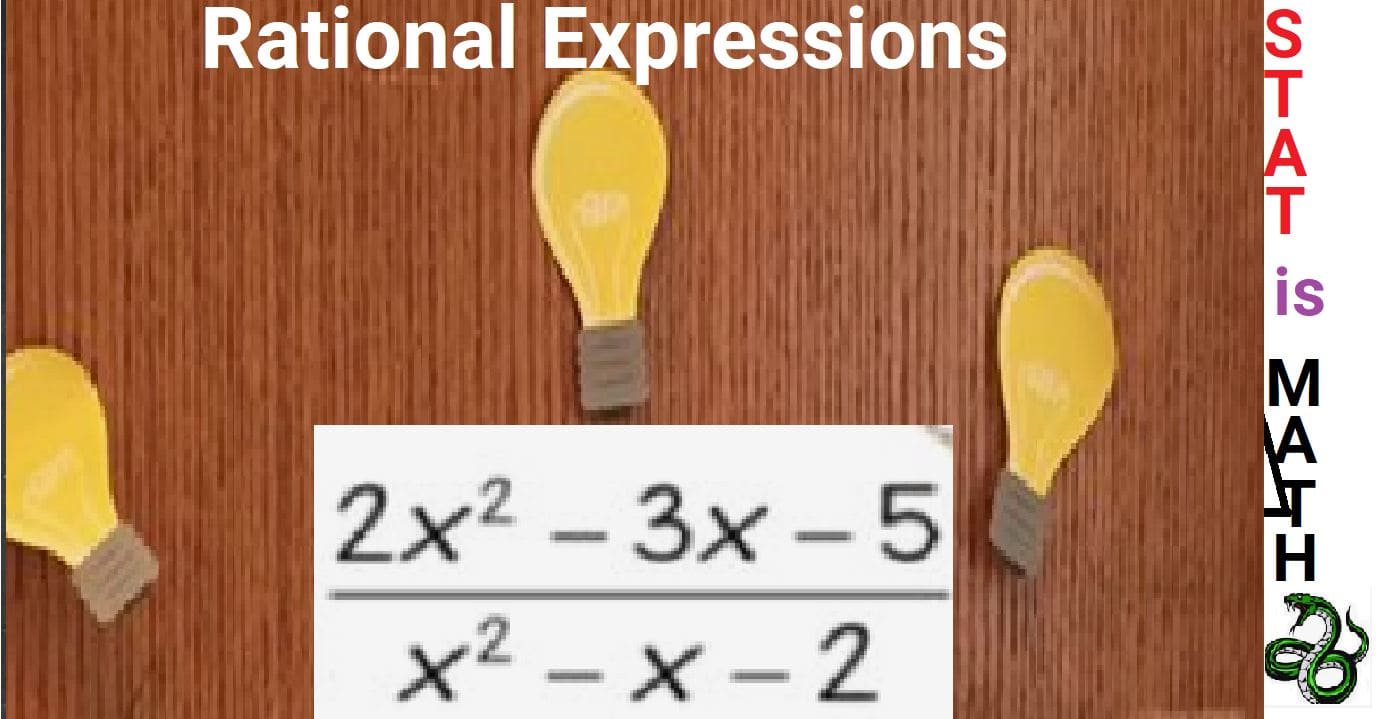
Rational Expressions
A rational expression is a fraction in which both the numerator and denominator are polynomials:
\[ \frac{P(x)}{Q(x)}, \quad Q(x) \neq 0 \] Example:\[ \frac{x^2 + 3x + 2}{x^2 - 1} \]
We can simplify by factoring:
\[ \frac{(x+1)(x+2)}{(x-1)(x+1)} = \frac{x+2}{x-1}, \quad x \neq \pm 1 \] Why Rational Expressions Matter in Calculus- Limits - Rational expressions often appear in limit problems, especially near points of discontinuity.
- Derivatives - Differentiating rational functions requires the quotient rule: \[ \left( \frac{f(x)}{g(x)} \right)' = \frac{f'(x)g(x) - f(x)g'(x)}{[g(x)]^2} \]
- Integrals - Rational expressions are common in integration, where techniques like partial fraction decomposition are essential.
- Graphing - Rational functions illustrate vertical and horizontal asymptotes, directly tied to the concept of limits.
- Physics: velocity functions with rational dependence on time
- Economics: cost and revenue models with rational terms
- Engineering: transfer functions in control systems