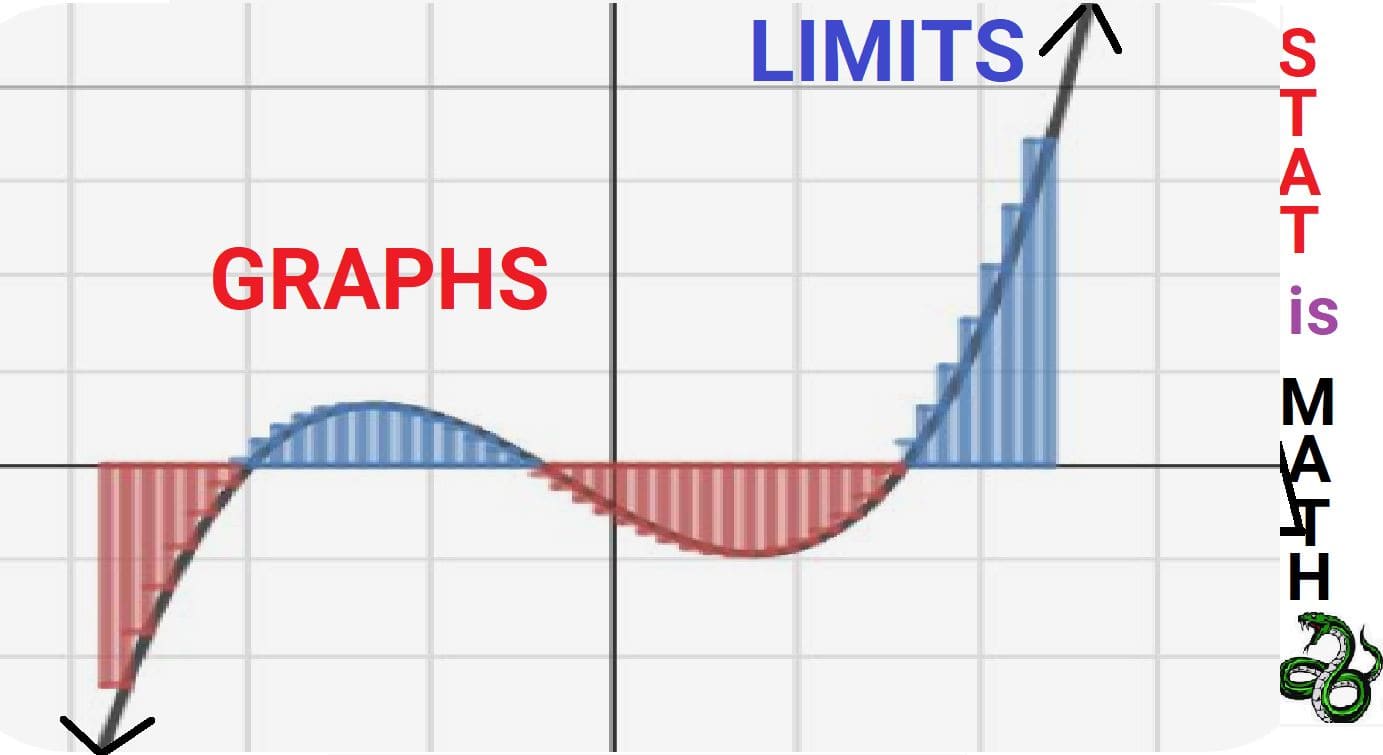
Graphs and Limits
Graphs are a powerful visual tool that help us understand the behavior of functions. By plotting a function, we can quickly identify its key features, such as:
- Intercepts: Where the graph crosses the x-axis or y-axis.
- Asymptotes: Lines the graph approaches but never touches.
- Behavior at Infinity: How the function behaves as \( x \to \infty \) or \( x \to -\infty \).
- Discontinuities: Points where the function is undefined or jumps.
Graphs provide an intuitive understanding of a function’s behavior and allow us to make predictions about its future behavior.
A graph provides a visual representation of a function’s behavior. It tells us things like:
- Whether the function is increasing or decreasing at a given point.
- If the function has any turning points, such as maxima or minima.
- Whether there are any asymptotes (vertical, horizontal, or oblique).
- The function’s continuity: whether it has any breaks or jumps.
- The overall shape of the function: linear, quadratic, cubic, etc.
By studying graphs, we can gain valuable insights into the function's behavior over time, such as predicting where the function will go in the future or how it reacts under different conditions.
Graphs are especially useful when analyzing the behavior of a function under basic boundary conditions. For instance:
- If a graph shows that a function approaches a certain value as \( x \to \infty \), we can infer the function's behavior at very large inputs.
- If the graph of a function has an asymptote, we know that the function’s value is becoming unbounded or approaching a fixed value at some point.
- If a function has a discontinuity at a certain point, the graph reveals where the function jumps or fails to be continuous.
These inferences are crucial when solving problems in various fields like physics, engineering, and economics, as they allow us to predict behavior under extreme or boundary conditions.
In calculus, a limit describes the behavior of a function as it approaches a particular point or as the input becomes infinitely large or small. The formal definition of a limit is:
\[ \lim_{x \to a} f(x) = L \]
This means that as \( x \) approaches \( a \), the function \( f(x) \) gets arbitrarily close to the value \( L \).
Limits are crucial in calculus because they allow us to define derivatives and integrals. They also help us understand how functions behave near points where they might not be defined or where they approach infinity.
Limits give us insight into the function’s behavior at specific points. For example:
- If a limit exists and is finite at a point, the function is continuous at that point.
- If a limit does not exist at a point, the function may have a discontinuity or an undefined value at that point.
- If the limit of a function as \( x \to \infty \) or \( x \to -\infty \) is a finite value, the function approaches a horizontal asymptote.
- If the limit of a function approaches infinity as \( x \to c \), the function has a vertical asymptote at \( x = c \).
Using limits, we can determine whether a function has any holes, jumps, or vertical asymptotes in its graph, providing us with valuable information for further analysis.
By analyzing the limits of a function, we can predict its behavior at various points or as the input gets larger or smaller. For example:
- In trajectory studies (such as predicting the path of a moving object), we use limits to understand the object’s velocity and position over time.
- In projectile motion studies, we can use limits to predict the height and distance a projectile will reach.
- In algorithm studies, limits help us understand the time complexity of algorithms as the input size approaches infinity.
- In stock market analysis, limits are used to model and predict the behavior of stock prices under certain conditions.
- Engineering uses limits to predict system behavior under stress, as in the analysis of materials or the prediction of machine performance.
- In AI, machine learning, and deep learning, limits help us understand how optimization algorithms approach a solution as they iterate towards convergence.
Consider a projectile launched from the ground with initial velocity \( v_0 \). The height of the projectile at any time \( t \) can be modeled as:
\[ h(t) = v_0 t - \frac{1}{2} g t^2 \]
As \( t \) approaches infinity, the height \( h(t) \) approaches zero (i.e., the projectile hits the ground). By analyzing the limit of \( h(t) \) as \( t \to \infty \), we can predict the time at which the projectile lands.
1. What is the limit of the function \( f(x) = \frac{1}{x} \) as \( x \to \infty \)? What does this tell you about the function?
2. For the function \( f(x) = x^2 - 4 \), calculate the limit as \( x \to 2 \). What happens to the function at \( x = 2 \)?
3. How do limits help us understand the behavior of functions at asymptotes?
Graphs and limits are fundamental concepts in calculus. Graphs provide a visual representation of a function’s behavior, while limits help us understand the behavior of a function near specific points or as inputs approach infinity. By analyzing limits, we can make predictions about a function’s behavior in various applications such as physics, engineering, economics, and machine learning.